NOTE Open Nixie Project
Test tubes
Farny made a test tube that will be possible to pump and fill with gas and then isolate by a high vacuum valve. He planned to use these test tubes to test pressures, gas mixtures, electrode distances, and many more parameters.
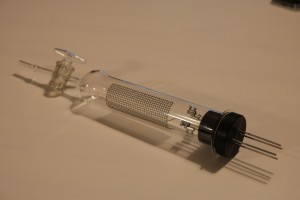
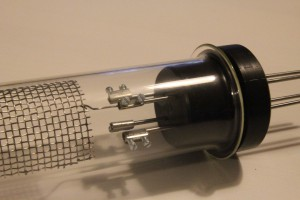
The black base was made of POM plastic, and a rubber o-ring was used to form a vacuum tight seal with the glass tube. The parts are held together just by atmospheric pressure. The pins of the tube were made from stainless steel bike spokes. The holes were drilled first, and then the pins were pressed into them, the pins should also be vacuum tight.
Farney appears to have used a common mesh grille as the anode of the tube, and some kind of screw terminal to be able to easily adjust the tube construction. If he didn’t do this, that’s a good idea!
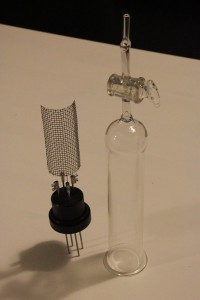
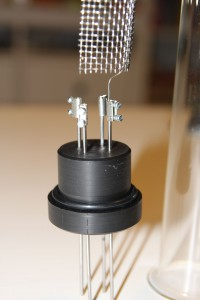
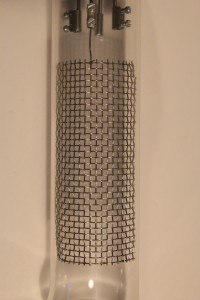
Using Farny’s previously outline process for tube testing, he tested the tube. The initial design works, with a good enough vacuum tight seal for short-term testing. According to Farny it was quite difficult to get the entire digit to light up, and suggested flattening the anode grid and adding a back plate - or alternatively adding a back plate and remove the anode grid.
The gas used in this test was argon, with a striking voltage of around 350V. The image below shows the glow at a lower pressure, somewhere around 1.9337\times10^{-2} psi, so it isn’t very bright.
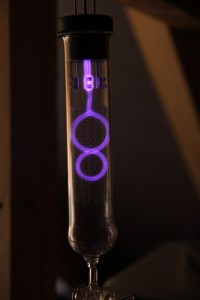
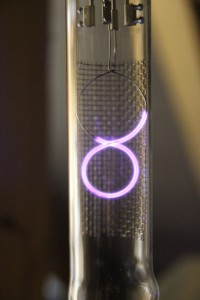
The below image shows Farny’s previous comment about difficulty getting the entire digit to glow.
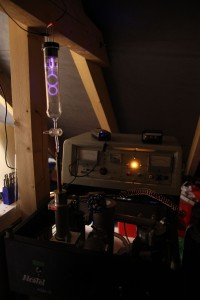
Below is an image of Farny’s full setup, it shows his leak detector used for pumping everything. Farny points out the needle valve and copper spiral, which is connected to a bottle with argon.