NOTE Open Nixie Project
Leak detector
To make a leak detector, Farny used two 230V AC fans, one for the diffusion pump, and one for cooling the electronics. His leak detector has two vacuum pumps, one for making a rough vacuum in the inlet port, and one for making a vacuum in the detection section (together with the diffusion pump).
When a tube is to be tested for leaks, the detection section is started first - it has to pump itself down to 9.668\times10^{-7} psi. The filament can be switched on at only around 1.9337\times10^{-7} psi and 9.67\times10^{-6} psi. At higher pressure the filament would react with oxygen and gradually burn off.
When the detection section is ready, the roughing pump is started. It pumps the inlet port with the testing tube down to 1.9337\times10^{-4} psi. Then, with the roughing pump still running, the manual valve between the detection section and inlet port is slowly opened until the pressure in the detection section rises back to 9.668\times10^{-7} psi, then the helium can be sprayed onto the testing tube to detect leaks. At this moment, the pressure in the inlet port is still 1.9337\times10^{-4} psi despite the fact that it is connected to the detection section which has a much lower pressure - since the manual valve is opened very slightly.
The full process is automated and controlled by solenoid valves, one opens the detection section, one allows the air to go inside (to atmospheric pressure), and one opens the valve with roughing pump.
The machine in this form - presumably this unit was purchased by Farny instead of built - doesn’t allow pumping the inlet port down to high vacuum because when the detection solenoid is opened the roughing port is also opened. Farny notes that he wanted to use this machine to pump the tubes down to a high vacuum, so he decided to add some user controls by cutting the wires going to the solenoid valves and connected them to three switches, one for each of air, roughing, and detection.
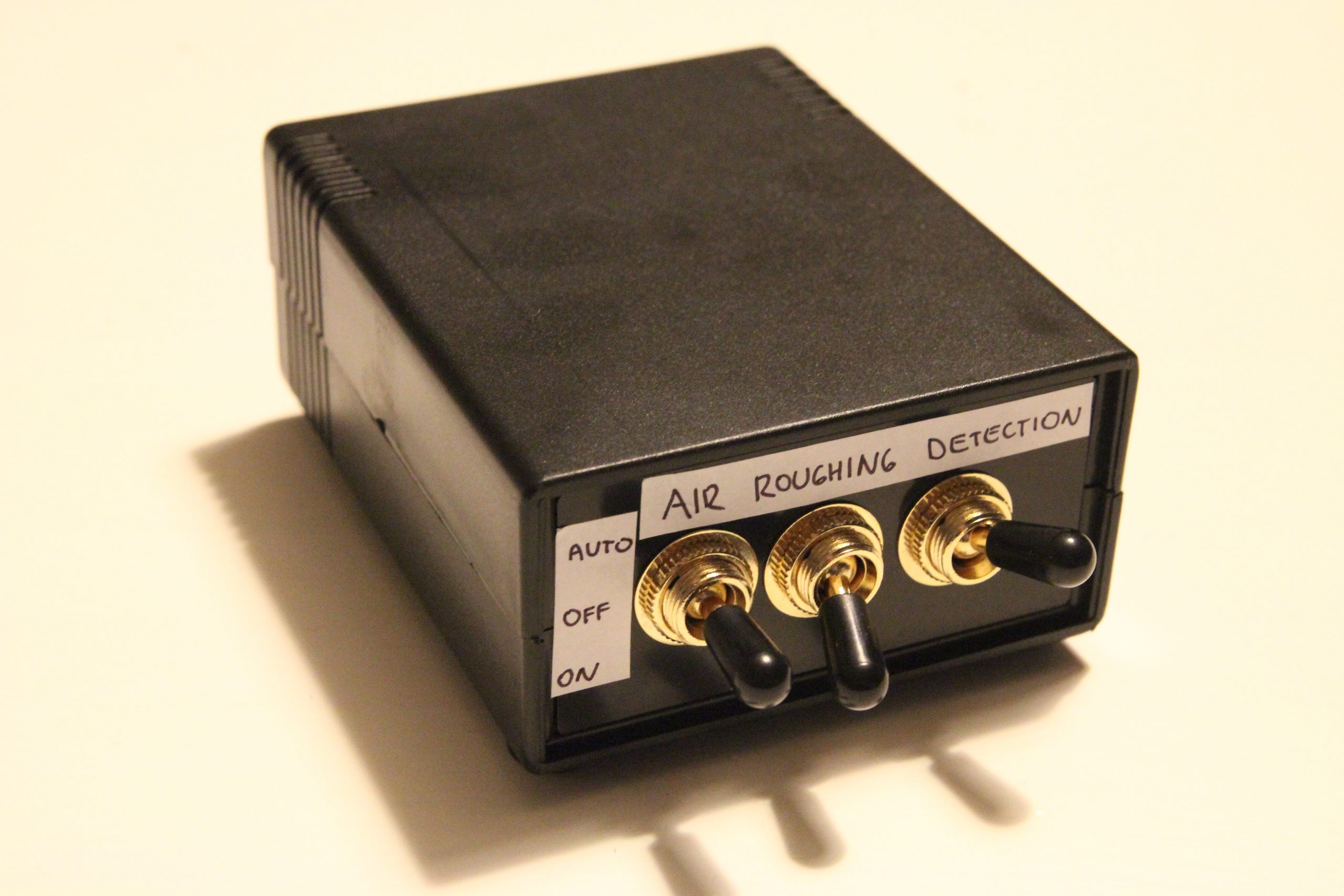
The box (a guitar 3 way selector switch) was connected to the machine by a 9 pin canon connector. Six pins are used for the three solenoids, and one for 24V AC taken from the machine’s transformer. The switches had to be modified to give the right states (A ON/B ON/Both OFF) instead of the original (A ON/B ON/BOTH ON). The solenoids could now be turned ON, OFF, or set to AUTO (controlled by the machine itself).
Now, Farny was able to control the solenoid valves independently. He could close air and roughing and let the inlet port be pumped just by the diffusion pump by opening the detection solenoid, and then it could be isolated by closing the detection solenoid, so it holds a vacuum and is filled by gas (and can now be used for making Nixie tubes).